
By giving way to Gopis, Yamunaji proved that Durvasaji is on an eternal fast. He never ate with the intention of feeding himself or nourishing his body, but his intention always was to feed Bhagwan, and he has been eating so eternally. When Balmukunddasji Swami tells a person that Bhagwan…

05. A true saint can confidently proclaim his purity
Gunatitanand Swami has said that there are four important accomplishments to achieve kalyan. Among understanding Bhagwan and understanding a true saint, which is more difficult? In fact, it is more difficult to understand a true saint than it is to understand Bhagwan. If a person lives with a true saint,…
04. A true saint is better than rushi, muni, devata, Bhagwan, and everyone
How can we say an object is better than another object? Only when we compare that object with another object can we say that the object is better than the other. The greatness of an object is measured by observing the difference between that object and all other objects. One…
03. A true saint makes sure Bhagwan never leaves his heart
Bhagwan never leaves the heart of a true saint, not even for a fraction of a second, and not even for the time taken by the eyelids to close and open. Even if Bhagwan wanted to, He can’t leave the heart of a true saint. We can see that through…
02. Six qualities of a saint who is as good as Bhagwan
If we want to associate with a true saint, we should first understand the process of identifying one. After identifying a true saint, we must surrender our mind and our life to him; we must listen to such a saint and mold our life accordingly. Nishkulanand Swami has said that…
01. Why should we know who is not a saint?
For the one who is on the path of moksha, it is very important to know the purity of the saint or devotee he is associating with. For that matter, if we find a true saint or even Bhagwan and if we don’t understand who exactly they are, then that…
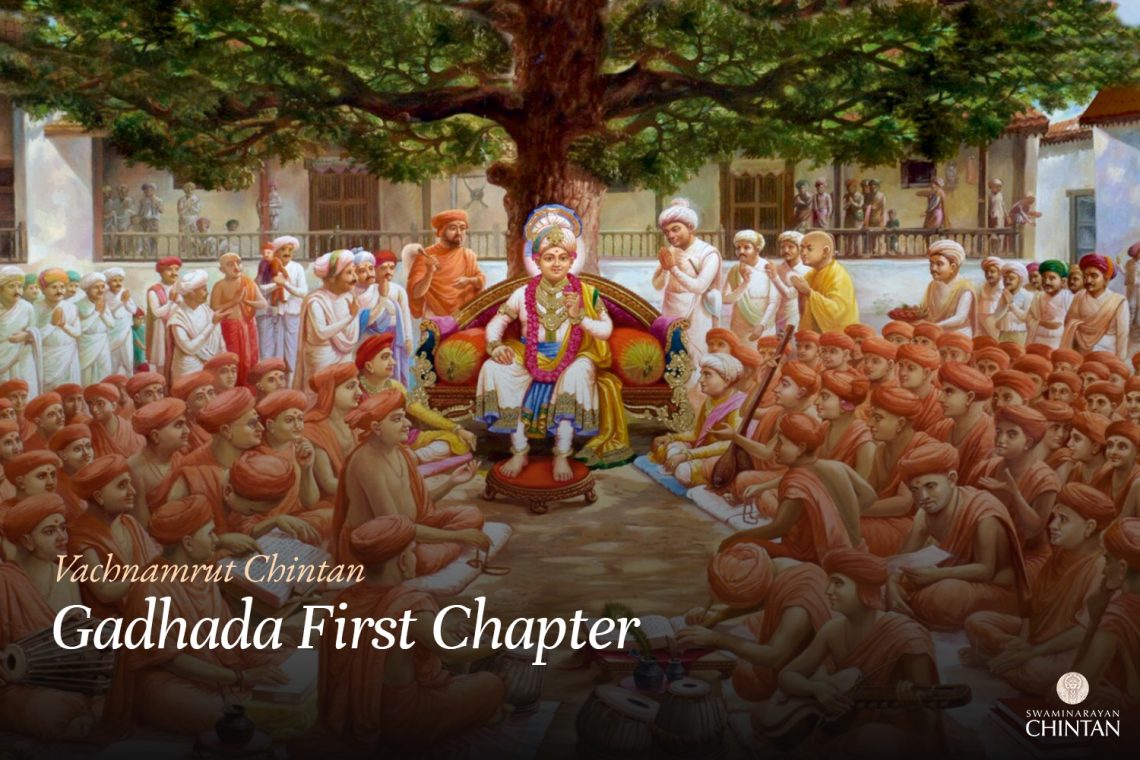
GF-01 Uninterrupted concentration on the Murti of God
Central Insights: Key Points: Commentary The first discourse of this Vachanamrutam discusses the purpose of engaging in an uninterrupted concentration on the transcendent Murti of Supreme God. In any religious text, the basic principle is to initiate with Mangalacharan (benediction prayer). When Mangalacharan also appears at the middle and end…
GF-33 Blind Faith, Love and Understanding
Central Insights: Key Points: Explanation The term ‘Ashray’ (refuge) is multi-faceted: Ashray: A place of rest, like a home. Ashray: A nurturer or guardian, similar to parents for children. Ashray: A protector for those who seek shelter. Ashray: To uphold sacred symbols and practices, such as the Tilak, Chandalo, and…
GF-49 Means to fix mind on God.
Central Insights: Key Points: Explanation In this Vachanamrut, Sadguru Brahmanand Swami asks a question: “It requires immense effort to keep our vrutti (focused consciousness) on Bhagwan, while it effortlessly remains engaged in worldly objects. Why is this so?” In response, Shreeji Maharaj explains that for those who are true devotees…
GF-67 Acquiring the Virtues of the Satpurush
Central Insights: Key Points: Virtues of a satpurush (true saint) are manifested in a seeker only when the seeker maintains divine intellect towards the satpurush and feels remorse for his own flaws and insignificance. Explanation In this Vachanamrut, Maharaj asks the saints if there are any such true saints who…
GF-02 Three Levels Of Vairagya
Central Insights: Clarification about the three kinds of Vairagya. Key Points: Worldly objects cannot control one who is not drawn toward them. Explanation विगतः रागः आसक्ति यस्मात् सः वैराग्यः । रंजयति इति रागः ।।vigataḥ rāgaḥ āsakti yasmāt saḥ vairāgyaḥ | raṃjayati iti rāgaḥ || Things that make us happy create …
GF-18 Influence of good or bad company
Central Insights: Key Points: Explanation This Vachanamrut is an expression of Maharaj’s compassion. While all Vachanamruts are such, this one has a special distinction. For one, Maharaj felt an urgency to convey this message early in the morning, with three parts of the night still remaining. After calling everyone, he…
GF-34 God has Set the World in Motion
Central Insights: Why, despite God being the source of endless happiness, are we so easily distracted by temporary worldly things? And even after discovering and connecting with God, who represents pure bliss, why do some of His followers still feel pain and sadness? Key Points: Explanation Bhagwan has designed the…
GF-50 Who can be called persons of sharp intelligence?
Central Insights: Key Points: Explanation This Vachanāmrut is about the sharp intellect. Shreeji Māharāj says that one who has a sharp intellect, attains the Brahma (Bhagavan). दृश्यते त्वग्रया बुद्धया सूक्ष्मया सूक्ष्मदर्शिभिः dṛśyate tv agrayā buddhayā sūkṣmayā sūkṣmadarśibhiḥ(Kaṭhopaniṣad 1.3.11) it is said in kathopanishad. Do those who know a lot about…
GF-68 God Forever Resides in the Eight Types of Murtis and in the Sant
Central Insights: Key Points: Explanation In this Vachanāmrut, Shreeji Māharāj says: “In Samvat 1869 whenever I entered Samādhi, it seemed as though I traveled to Purushottam-puri and resided within the idol of Jagannathji. Through the eyes of that idol, I saw everyone, including the devotion and deceit of the priest.…
GF-03 Remembering The Leelas Of God
Central Insights: Leela (exploits/pastimes) of God should be remembered, and relationships with Santos, Brahmchāries and Satsaṅgis should be developed. Key Points: At the time of death, if one cannot visualise the divine image of God, remembering the Leela Charitras (exploits/pastimes) of the Supreme Lord and recalling the memories of Sadhus,…
GF-19 The Interdependency of Atmanistha and Other Virtues
Central Insights: Key Points: Explanation In this Vachanāmrut, Māharāj says: “In our Satsaṅg devotees of God desire for their ultimate salvation. It cannot be achieved by alone Ātmanishthā, love for God, Vairagya (non-attachment), or Swadharma. Ultimate Mōkṣha requires practice of all four virtues.” Each virtue has its own significance &…
GF-35 Safeguarding One’s Salvation
Central Insights: Key Points: Explanation Then, addressing the Santo, Shrījī Maharaj said, “Either you ask Me a question or I will ask you all a question.” Thereupon, the Santo said, ‘You may ask, Maharaj.” Then Shrījī Maharaj replies, “There is an individual who, despite having limited intellect, never refrains from…
GF-51 Only a Diamond Can Cut a Diamond
Central Insights: Key Points: Explanation In this Vachanamrut, Purnanand swami asked a question : ten senses are of rajas nature (of Maya), four consciences are of sattva nature (of Maya). Therefore, all senses and consciences belong to Maya, and bhagavan is beyond it. Then how come the determination of bhagavan…
GF-69 The Dharma of a Wicked Person and a Sadhu
Central Insights: Key Points: Explanation In this Vachanamrut, Shriji Maharaj posed a question: What is the definition of dharma? Provide an answer according to the scriptures. Even the violent kings who came for refuge would neither kill a living being nor allow others to kill. Thus, those who sought refuge…
GF-05 Persistency In Dhyan
Central Insights: Key Points: Even if God’s divine Murti (form/image) is not visualised, a devotee must always remain persistent and meditate enthusiastically upon the Murti of God. Explanation Here Shreeji Maharaj ordains His devotees to meditate on the divine Murti of Lord Shree Krishna along with Rādhikāji. This order creates…